This page added on Sunday, 10th April 2011
If you've seen a number of other pages in this website, and if you're
familiar with one of the best-known occurrences of the familiar
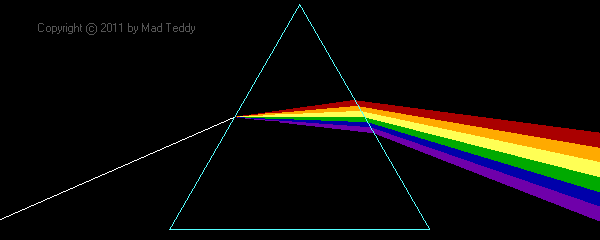
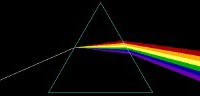
dispersive prism
pattern in popular culture, you're probably thinking: “That'd be right -
we all know that old Teddy really likes Pink Floyd's "Dark Side of the
Moon"; and now here he is getting all psyched up to rabbit on about it yet
again...!”
Well, if that's what you're thinking, you're absolutely right!
But you may also be thinking, somewhat indignantly: “...and he has the
cheek to scan or photograph that prism picture from the album cover,
slap his own copyright label on it, and try to pass it off in his website
as his own work!”
However, this time you'd be wrong. It really is all my own work. I
produced the graphic using a DOS BASIC program I wrote myself; used
Neopaint to do a bit of "pixel touching-up" and add my copyright notice;
and then used DISPLAY to crop it from its original 640×480-pixel size down
to 600×240 pixels. The result is as you see above. (If you'd like to have a
look at my BASIC program, click
here.)
Actually, if you're familiar with the album art of "The Dark Side of the
Moon", you may notice a subtle difference. In my version, I've depicted the
spectrum colours within the prism as well as in the emerging
refracted beam - which doesn't occur in the Floyd's
artwork,
thus providing further evidence, should any be needed, that I did not
plagiarize. So there!
“Okay then,” your thoughts may continue, “so what's all this got to do with
rabbit-holes, anyway?”
Well, there is a reference to a rabbit digging a hole in the
lyrics
of
"Breathe",
the first
song
(in the sense of having actual sung words) in the "Dark Side..." album:
- which we can probably relate to in our frenetic 21st century world. But
that's not quite what I have in mind at the moment. So what is my
point, then?
It's a fair question. Bear with me; all will be revealed. Read on.
Just before plunging in: it's perhaps worth noting that, in 2006, the ABC
ran a "My Favourite Album" survey - and the winner was "The Dark Side of
the Moon"! (Click
here
to see the "Top Ten" list.) I wasn't too surprised at the result,
because the album seems to address the
human condition
in a very powerful way to which people can relate easily. (As noted
in that ABC page, there are some real surprises in the list; but I can
definitely give a "thumbs-up" to the winning result - if not, perhaps, to
one or two of the others!
For Christmas last year (2010), a family member (who knows the sort of
thing I like) gave me a copy of "Lewis Carroll in Numberland", by Robin
Wilson. I just finished it two or three weeks ago - that is, all except for
attempting some of the more arcane mathematical and logical puzzles
described therein. (I'll get around to them all eventually, don't you
worry.)
Click
here
to read a rather good review of the book. Note the reference to Queen
Victoria, who enjoyed "Alice's Adventures in Wonderland" but who was Not
Amused when, having asked to be sent a copy of Lewis Carroll's next
published book, she was presented with
AND ALGEBRAICAL GEOMETRY.
MACMILLAN AND CO.
Although
Asperger's Syndrome
was not a recognized condition in Lewis Carroll's time (in fact,
Hans Asperger
himself only identified it in the mid-1940's, long after Carroll's death),
there is now at least a suspicion that Carroll was indeed an Aspergian (as
I am myself; I've told my story in my
On the spectrum
page - in which, just by the way, there is a reference to one of the
songs from "The Dark Side of the Moon", near the bottom of the page!
We are an odd lot, by most people's standards. We tend to get fixated by
the things that interest us to the point that we may become - to put it
mildly - boring, to most
("neurotypical")
people.
An example is given in the book. One of Lewis Carroll's young friends once
had this to say about him:
His great delight was to teach me his Game of Logic. Dare I say this made
the evening rather long, when the band was playing outside on the parade
and the moon shining on the sea.
Of course, 42 is famous for being the Answer to the Ultimate Question of
Life, the Universe, and Everything, in "The Hitchhiker's Guide to the
Galaxy" by Douglas Adams. Again, click
here
if your knowledge in that department is lacking, and you wish to be In The
Know.
Actually, those two links point to two distinct sections within the same
Wikipedia page - the one about the number 42, the link to which is
here.
There's lots of information in that page, some "sensible" and some
not; indeed, it's reassuring to know that Wikipedia doesn't take itself so
seriously that it can't include a bit of nonsense within at least
some of its hallowed pages. (It wouldn't surprise me one little bit
to find out that the entire page was compiled by someone with Asperger's,
simply doing what comes naturally.)
ANYWAY, this all gives us some kind of much-needed connection to this page's title:
the story of Alice begins (as I'm sure you know) with her following a white
rabbit down its hole and into a very strange (and, in some ways, rather
frightening) world.
My goodness - what a rough start it's been to the new year of 2011.
Down here in Australia, the years-long drought has well and truly broken -
but it's been, to put it mildly, a mixed blessing. We've had massive
flooding over the eastern half of the country, especially in Queensland and
Victoria. (In parts of Queensland, there was a truly horrifying
"inland tsunami",
as the floodwaters came rushing down into the valleys and caused colossal
damage.) New South Wales has copped some of it, as have parts of South
Australia - and we've even had a bit of flooding in my home state of
Tasmania. (That's the small island at the south-east corner, which gets
left off maps of the country
with monotonous regularity.
Then, just when people up north were starting to assess the damage and pick
up the pieces,
Cyclone Yasi
arrived and kicked the guts out of the area again. Its effects extended as
far west as the Northern Territory; even the central Australian town of
Alice Springs felt its effects. Click
here
to get some idea of the size of this monster on a global scale.
To add insult to injury, in early February there were some very nasty
bushfires
in south-west Western Australia. So, one way and another, we've had pretty
much continent-wide natural disasters down here in Oz for the past few
months.
Then, as though there hadn't been enough
"acts of God"
to deal with, the New Zealand city of Christchurch was hit by an
earthquake
- apparently, a large after-shock following the earlier quake in September
last year (2010). This one was of less intensity (6.3, as oppposed to the
7.1 of last year's event), but closer to the city, so that the damage was
much more widespread.
As if all this wasn't enough - on 11th March, just about a month ago, there
was another
earthquake
- in Japan this time - of magnitude 9.0, and an associated tsunami about
ten metres high in some parts. The story of considerable ensuing damage to
some nuclear power stations, with serious radiation leaks, continues to
unfold as I write this. Then, on the evening of 25th March came the news of
yet another earthquake, this one near the Thai/Burma border.
How much worse can it get? It seems as though our Earth is shaking itself
to pieces. Is it a sign of the
"End Times" ?
I don't know. It may be! I don't belittle such ideas. In fact, as a young
evangelical Christian in the 1970's, I took considerable interest in
Eschatology,
along with many other young Christians of that era.
But as I've grown older, and taken on such everyday things as family
responsibilities, I've come to realize that - come what may - life has to
go on. Jesus himself said that
"of that day or that hour no one knows...".
He then said to
"watch!".
I take this to mean that Christ will definitely return, and that we
should be aware of the fact and always ready and prepared for it to occur
at any time - but that, meanwhile, we simply have to get on with what we
need to do in our ordinary lives. For me personally, this means that I
have to be concerned that my children and grandchildren [so far, I am
"Grumpy" (or "G'umpy", to be more precise) to one little granddaughter]
will have a life into whatever "ordinary" future there may still be; and
part of that process is that I need to maintain this website. So here I am,
writing yet another page with that firmly in mind, and on the principle
that - as long as we're all still here -
it's never too late
to make a difference.
So - back to the humdrum matters of day-to-day life!
On Monday 14th March, there was an incident in a Sydney high school which
"went viral" on the web. In the unlikely event that you haven't heard about
it, click
here
to bring yourself more-or-less up to speed.
A 12-year old boy (whom I'll refer to as "the little kid", rather than
using his name) was repeatedly hitting an older boy, 16 (whom I'll refer to as
"the big kid", for the same reason). The big kid fended off the blows as
well as he could, until eventually he "snapped", grabbed the little kid,
lifted him up, and dumped him unceremoniously - face down - onto the
concrete path. The little kid's leg was slightly injured, but he was able
to stagger away with a pronounced limp.
A third kid filmed the incident on his mobile phone. It took me a bit of
time to find it on the web. It had originally been posted on YouTube, but
they "pulled" it quite quickly. After a bit of hunting, I found it on
another video site.
I'll admit that I was one of many around the world who said
"YAY...",
when I first saw it.
- - - - - - - - - -
I know what it's like. I've told my story in somewhat general terms in my
On the spectrum
page (already mentioned above). It was no fun being picked on because I
was a
"Pom",
or because I was the youngest in the class, and somewhat more "academic" -
and far worse at sport - than most of the others.
It wasn't all bad. In primary school, I did have a couple of good
friends (as mentioned in that "spectrum" page). Things could have been
worse. But, for the most part, at recess - not so much at lunch-time, as I
used to go home for that, normally - I'd generally hang around pretty much
by myself, and thus avoid trouble as far as possible.
Of course, it didn't always work. I was probably in Grade 5 or thereabouts
when a little "tough guy", a year or two younger than I, decided that he'd
have a "pop" at me. Every so often he'd come up to me and try a bit of the
old push-and-shove routine. It was notable that he always had a
wimpy-looking kid with him - his "disciple", I suppose - whose function was
presumably to observe the proceedings and cheer him on. (Or perhaps it was
some kind of master/apprentice relationship? Who knows...) Anyway,
this other kid never said or did anything remotely impressive that I saw;
just traipsed around after the "tough guy".
One day, I just had enough. I gave the punk a somewhat diffident
underarm
prod in the stomach with my fist, and was astonished to see him double
over in agony and stagger away, with his anæmic-looking little pal in tow.
For a second or two, I thought he must be faking it for some strange reason
(I didn't know anything about sarcasm or derision at that
tender age); but - no, it was "for real"! Apparently, I'd hit him right in
the solar plexus and completely knocked the wind out of him - and yeah, it
felt pretty good to realize that I'd successfully stood up for myself!
Shortly thereafter, guess what? His little offsider came up to me with a
serious look on his silly little face to tell me that his "main man" was
going to
dob me in,
and that I was going to be in trouble as a result. Of course, I didn't know
the far more recent expression "Yeah, right" - but that's the sort
of thing I was thinking. (I'll admit to having been slightly
worried.) Then the wimp scurried off, probably thinking that he might be
next if he didn't get his skates on. Whether his "hero" saw the error of
his ways and decided to behave himself thenceforth, or whether he found
someone else to try his jostling tactics on, I don't know - but either way,
I never had any bother from him or his pathetic little shadow ever again!
%
%
%
%
%
So I savoured my first ever taste of "rough justice" (in the sense of
approximate justice) - and this is one reason I wanted to mention
Pink Floyd's "The Dark Side of the Moon" album in this page. In some of the
songs from this album, there is an undercurrent of
low-volume comments
made by various people associated in some way with the band, each such
comment somehow related to the lyrics of the particular song in which it
occurs.
Roger Waters,
the Floyd's bass guitarist, was very largely behind this part
of the "Dark Side of the Moon" project. He organized a series of flash
cards - each featuring a short, pithy question - which were shown to people
in order to elicit "off the cuff" responses, which were recorded and (in
some, not all, cases) later incorporated into the album. (In one case, an
actual live interview was recorded - because the flash cards had gone
missing!
Some of these questions - and the answers to them - have to do with fear of
dying; others are about violent behaviour, and people's responses to it.
The overall impression is one of anxiety and unease.
Robert Sandall,
a British music journalist and radio presenter, expressed it as follows:
I think what the voices did on the record was they actually brought out
"the dark side"; they were, in a way, the dark side of the record.
You can read a reasonably straightforward history of the album
here.
If you'd like to read a somewhat rambling - but very interesting - summary
of how the album came to be made, with quite a bit of detail about
instrumentation, arguments about copyright for various sections, and of
course the somewhat "ill at ease"-sounding spoken remarks just mentioned,
you might like to spend a few minutes reading through
this
web-page.
One of the "voice" contributors (the one who was actually interviewed live)
was
Roger "The Hat" Manifold
who uttered the classic
"short, sharp shock"
comment which came to be included in the song "Us and Them". Click
here
to view a YouTube video featuring the original recording of Mr. Manifold's
spine-chilling remark; and
here
for a YouTube video of "Us and Them", in which it is featured. (If you'd
like to hear a fuller version of the conversation between the two Rogers,
click
here.
Good for a chuckle...)
So, as a primary school kid, I gave that rotten kid a "short, sharp shock"
- more by luck than good judgment, I think. After all - to continue to
quote from Roger "The Hat"'s recorded remarks -
"Good manners don't cost nothin', do they? Eh?!"
The only regret I have is that this all happened nearly half a century ago,
long before there were such things as mobile phones, the internet, or
YouTube, which otherwise would have made it possible for me - or some
trusted ally - to film the entire event and post it online! Now that
would have been fun - as well as being an object lesson for any other
aspiring young thug: "Don't mess with Teddy - OKAY??"
It wasn't quite so simple in high school, though. With the hormones
beginning to flow in both sexes by about Grade 9, bitchiness was
flavour of the month. There were the occasional threats of violence from
some of the more meat-headed boys, and sometimes you'd indeed get a "slap";
but it was far more about name-calling, jeering, sneering, betrayal,
ostracism, and generally
extracting the Michael
- you know the sort of thing. You just couldn't take a trick.
It seemed as though everyone was permanently on ones case, boys and
girls alike. Of course, most of them weren't; but in the middle of all the
confusion and desperation, it seemed as though the whole world was
in on it - which, of course, was exactly the effect intended by the brats.
(The fact that neurotypical people are supposed to have so much more
empathy
than we Aspergians is one of the most mystifying paradoxes of all time, in
my humble opinion.
One incident sticks in my mind. After a PE session, all the boys were in
the toilets/change-room area, getting changed to go back to class. That's a
bad environment at the best of times. The noise level was high; I was
getting the usual treatment - and eventually I just lost it and lashed out,
hitting one lad who was totally innocent (in fact, he was a nerd like me,
but somehow he knew how to avoid the
slings and arrows
of the mob). The taunting ground to a halt, and they all left the area. I
was one of the last ones out. Ever since, even though my fury and
frustration were perfectly justified, I've felt bad about thumping that
fellow, because he certainly didn't deserve it. He's probably forgotten all
about it all these years and decades later; but just in case he's reading
this and it rings a bell - sorry, mate!
- - - - - - - - - -
The Concise Oxford Dictionary, eighth edition (1990), defines "bully" as
follows:
bully1 n. & v. -n. a person who uses strength or
power to coerce others by fear. -v.tr. 1 persecute or oppress
by force or threats. 2 (foll. by into + verbal noun) pressure
or coerce (a person) to do something (bullied him into agreeing). ...
(It goes on to define "bully-boy" as "a hired ruffian"; and then there are
three more totally different meanings of the word presented, to do with
such things as beef and hockey.)
Is that a helpful definition? It seems a bit old-fashioned to me. No doubt
that's a part of it; but in normal everyday usage, it seems to me, bullying
is more about inflicting gratuitous physical and/or mental torture on an
innocent, undeserving person, for no real reason, good or bad. Just getting
ones kicks from another's suffering, basically.
Personally, I think it's an unfortunate word. It sounds a bit too "goofy";
perhaps too much like simple teasing, or little more than a gentle form of
"stirring" - having a bit of fun at another's expense, perhaps with a
touch of more-or-less rude humour thrown in. But that's not what I remember
from my high-school days - and it certainly has very little to do with what
we saw happen in Sydney recently. That was deadly serious.
I think we need a new term, which carries with it the idea of ritual
abuse, of psychological torture, of banal evil; and until
we either come up with a suitable term (perhaps something like
"feral
bastardry")
- or at the very least begin to take the matter a whole lot more seriously
than we have been doing, whatever we choose to call it - the problem will
persist, and probably worsen over time.
The Sydney incident unleashed an amazing flood of angry - even vitriolic -
comments on the web. Quite clearly, there are many, many people around the
world who know from first-hand bitter experience what this is all about,
and who really cheered when they saw on their computer screens someone
taking the matter into his own hands and dealing with it in a decisive way
- and, as I've already mentioned, I was exulting with the rest of them.
But this can get out of hand. I saw YouTube videos from two fellows who
were both celebrating - in quite strident terms - the big kid's action in
sorting out the little kid; but, since then, I've seen follow-ups to both
these videos in which it's clear that these two characters have had a bit
of a re-think in the wake of the quite frightening malicious comment that
has since proliferated over the internet - and in their second videos, both
are looking rather shamefaced at their initial reactions.
Since the incident, there have been TV interviews with both kids involved
in the fracas - the big kid first, the little kid later - presented by two
commercial TV channels whose current-events programs compete vigorously
with each other for ratings. (Both these interviews are, as I write this,
on YouTube.) But any light that may thus have been thrown on the matter has
been compromised by the fact that these two outfits have engaged in
less-than-honourable competitive behaviour in obtaining those interviews,
to the extent that the entire process has been cheapened in the name of
profitability. If you really want to follow this up, you can get some idea
of what it's all about
here
or
here.
(Within that second link, to the ABC's "Media Watch" program, select
Episode 8, 28 March 2011. It's the item entitled "Chequered treatment".) I
suspect that neither of the kids, nor their families, will look back on
this time with any great sense of pride in years to come.
So what can we say about the Sydney incident, with the benefit of
hindsight?
The first and most obvious conclusion, from where I'm standing, is that the
usual spiel given by schools about how they have "policies" on bullying,
and that they "work consistently within them" to "protect" their students,
and "deal with all cases of violence" according to their "community-agreed
discipline code" etc. etc., is just so much mealy-mouthed claptrap.
Somewhat as victims of sexual abuse frequently feel "re-victimized" by the
courts, so victims of bullying are often made to feel abused all over again
by the very systems that have ostensibly been put in place to look after
them.
(As a classic example of the sort of thing I'm talking about, click
here
to read the story of how a girl at another suburban Sydney school
was asked by the school to sign a "pact" with her tormentors - thus giving
at least the appearance that she agreed that she was in some way
partly to blame for her mistreatment.
All the current system of telling kids to "walk away" from nasty situations
achieves is to legitimize the power of the bullies to control the movements
of their victims. Why should any kid be forced to run away all the time?
There is absolutely no justice in that!
As far as I'm concerned, in the absence of any real protection by schools
for their terrified and traumatized at-risk students, if a bully gets hurt
by some victim who has finally "snapped", then the "justice" may be rough,
but it's better than none at all.
Further: if a kid who stands up for him/herself while being victimized, and
is then given further ill-treatment in revenge, as some of the
politically-correct brigade direly suggest is likely to happen (almost as
if they want it to happen, so as to feel vindicated in their
sanctimonious thinking) - then, if "Round Two" occurs in school time and/or
on school property, with ensuing consequences, as far as I'm concerned the
school is to blame for failing in its duty of care (twice),
and should be held very firmly responsible!
I believe that the glee which spread over the internet in the wake of the
recent big kid's treatment of the little kid in Sydney was (initially, at
least) a perfectly understandable expression of outrage at the way
political correctness has eaten away at the rights of ordinary people to
safeguard their legitimate interests. Notwithstanding any claims by a bully
to have been a victim him/herself at some stage in the past (as in the case
under discussion here), the victim in a given immediate situation has a
natural right to protect his/her life, limb, and sanity. Or, to put it
another way: as Bob Dylan sang in
"Do Right To Me Baby (Do Unto Others)"
from the album
"Slow Train Coming",
[I] don't want to be used by nobody for a doormat...
Of course, there are huge risks in standing up for oneself (or for somebody
else, for that matter). Consider what could have happened in the
recent Sydney case, had the little kid landed on the concrete path in a
slightly different orientation:
1.
His leg could have been broken, rather than simply grazed;
2.
He could have ended up with a broken neck, which might have necessitated
having to spend the rest of his life in a wheelchair - or he could possibly
have died on the spot from the injury;
3.
He could have suffered a fractured skull, maybe with major brain damage or
- again - instant death.
Perhaps it's possible to make a case for saying that the first of these
three would have "served him right"; but what about the other two cases?
The big kid would have to spend the rest of his life knowing that he had
maimed (or perhaps even killed) the little kid - and, surely, there could
never be any winners in a situation like that. This time, fortunately,
everyone simply got lucky.
If the schools are serious about wanting to really deal with this issue,
and prevent serious injuries (or worse), then they need to get away from
the lazy, slogan-and-cliché-ridden, politically-correct approach that
they've used for far too long. Here are my suggestions:
1.
Install CCTV cameras to cover the entire schoolyard (or, least, as much of
it as possible), to be run during recess and lunch breaks - as well as
before and after school for as long as reasonable - and have their output
both monitored live by staff members and also saved to media, so that any
nasty incidents will be "on the record";
2.
Have a policy of one warning only to offenders, after which the
punishment for subsequent violations will be expulsion from the
school - no ifs, no buts;
3.
Ban mobile phones from schools, or at least severely restrict their use by
requiring that (a) they must be registered with the school office; (b) they
must be deposited at the office before school, to be picked up at the end
of the school day; and (c) during school hours they may only be used, under
supervision, within the office environs for bona fide purposes, with the
recipient's name and phone number to be recorded - again, with a policy of
one warning only for any usage outside the guidelines - and must be
left at the office at the conclusion of the call; (d) any misuse on school
property - including before or after school hours - will lead to immediate
confiscation of the device, which may then be returned to the kid's parents
(or even, perhaps, given to the police, if the seriousness of the offence
warrants it);
4.
For exactly the same reason, ban cameras of any kind except for legitimate
purposes related to school projects, with similar punitive measures in
place for inappropriate use.
Granted, installing extensive CCTV coverage isn't going to be cheap, and
monitoring it will be resource-intensive - and, of course, it won't cover
such areas as toilets and change-rooms. But, at the very least, it will
give at-risk kids a sense of confidence that there are at least some
areas they can go to where they know that whatever happens to them
will be seen, recorded, and acted upon - and that in itself will be at
least somewhat empowering.
(The toilet/change-room situation is more tricky, of course. Although it
may be impractical, I suggest installing a carefully-placed "panic button"
in such areas, perhaps with a finely-focused fixed camera monitoring it, so
that kids know that they can summon help quickly if they need it, and that
any abuse of the facility will be recorded and appropriate action taken by
the school. I'm just presenting some ideas, okay?
Something needs to be done!)
To be honest, I can't see any valid reason for schoolkids having
mobile phones in school. When I was a lad, "back in the good old days"
(yeah right), if it was necessary for parents or guardians to
communicate with their youngsters - for example, to take them to doctors'
or dentists' appointments etc. - there was a phone in the school office,
and there was a perfectly serviceable P.A. system whereby a kid could be
called to the office to receive messages as and when necessary. So what's
changed?
School is supposed to be a safe environment where teaching and learning
take place. What has any of that to do with kids sending each other
secret messages (instead of concentrating on their school-work), engaging
in "cyber-bullying", or filming abusive situations for publication on the
World Wide Web?
COME ON!
None of this is easy. As adults, we've "been there, done that", and perhaps
seen the problem from both sides (nobody is totally squeaky-clean, after
all). I'd like to conclude this section on school bullying with the the
first few lines of
"Teach Your Children"
by Crosby, Stills, Nash, and Young - a song which was popular in 1970. (I
didn't really understand it back then, but I think I do now, at least to an
extent.) Perhaps it gives us all - adults and kids alike - something to
think about and aspire to:
You, who are on the road,
If you'd like to listen to this song on YouTube, click
here.
If you'd like to follow the entire lyrics while listening to it, you can
find them
here.
- - - - - - - - - -
Workplace bullying is perhaps one of the most insidious expressions of the
phenomenon. Here, the classic schoolyard bully is replaced by the
unscrupulous "ladder-climber"; the ambitious, ruthless "CEO"; or the
tea-room gossip. There are all sorts of ways of metaphorically stabbing
people in the back while assuming an air of decency and respectability.
This is at its most blatant when it becomes institutionalized, legal - or
even mandatory. In Australia, prior to the 2007 federal election, we
had a federal government which tried to force an iniquitous piece of
legislation, euphemistically entitled "Work choices", onto the Aussie
people. It was anything but; its main thrust was to make it possible
for employers to dismiss people unfairly, thus handing CEOs
virtually unlimited power to engage in workplace bullying in the more
old-fashioned sense of coercion ("...be in here and do the extra
shift or face the sack", etc.).
When right-wing governments side with employers against employees, ugliness
knows no bounds. The old Biblical (often misquoted) saying
"The love of money is the root of all evil"
is surely a direct challenge to the politics of Reagan, Thatcher, Howard
and their ilk, in which "the economy" and the profit motive are seen as
more important than absolutely everything else, including the very notion
of humanity. To quote Bob Dylan again:
“Money doesn't talk, it swears.”
“There is no such thing as society.”
At first glance, that statement - when read in the context of the entire
interview - does perhaps sound "reasonable". However, it's not too
hard to read "between the lines" and see it in a somewhat different light.
Do please visit the following two web-pages to gain another perspective:
http://www.scn.org/cmp/modules/per-per.htm
(Although the word "glib" is not used in either of those two pages to refer
to the "Iron Lady"'s comment, I suggest that it's entirely appropriate in
that regard!)
"Work choices" was probably the straw that broke the camel's back for the
Howard government; among its many abuses, this was the one that hit home
hardest for the ordinary Aussie citizen and ultimately spelled the end of
that administration in November 2007. My earlier
"...new millenium..."
page (mentioned above), posted in early 2008, was very largely about this
matter.
But it's when office politics is about people's immediate superiors
humiliating them by "shutting them out of the loop", belittling or
pointedly ignoring their input, or micromanaging their every action - or
when it's about treachery, character assassination, or simple sly innuendo
from colleagues (things that you can't prove) - that it is perhaps
at its meanest and nastiest.
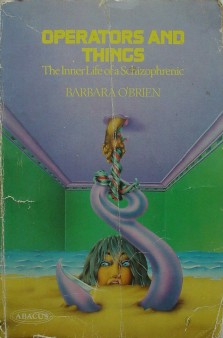
In 1976, I found in the Uni. of Tasmania bookshop a very intriguing-looking
book entitled "Operators and Things: the Inner Life of a Schizophrenic" by
Barbara O'Brien (1958; this ABACUS edition was published in 1976). It
wasn't so much the title that grabbed my initial interest as the book's
very alarming cover illustration. Visit
this
page to read some reviews, and find out where you may be able to obtain a
copy if you'd like to.
I was surprised to find it enormous fun to read. It tells the story
of one woman's experience of working in an office environment in which the
slimiest form of office politics held sway, as those around her all strove
to climb over each other to advance their own selfish, greedy ends.
(You can see by the condition of my copy's cover, above, that this is a
much-reread book!)
She refers in the book to the manipulative people in her workplace as "hook
operators". Not being the sort of person who thought or behaved as they
did, she didn't understand them - and became terrified of them. (Even
though she left the job through resignation, rather than by being hounded
out, she did experience a small amount of trouble from one of the hook
operators prior to doing so - so she knew what could happen.)
She suffered a mental breakdown, developing schizophrenia. She began to see
and hear shadowy "people" who controlled her life for several months. When
they were not visible (which was most of the time, after the initial
"encounter" when three of them "introduced" themselves to her), they were
there as voices in her head - lots of them! She tells the story of
how, in response to some of the more "helpful" of these characters telling
her what to do to, she travelled around the US on Greyhound buses to try to
find a way out of her unpleasant situation.
The "voices" called themselves "Operators", and referred to her as a
"Thing". They informed her that humanity is divided into these two groups:
the "Things" (ordinary people like you and me), and the "Operators", who
can communicate with each other by telepathy and who control the Things.
Somehow, it seems, as a result of some error on some Operator's part, she
had become aware of them - her head was now "open" - and they desperately
wanted to get it "shut" again, to restore the status quo.
(2nd March, 2012:
Actually, that's not quite right. Having reread the early part of the story
again, I find that Barbara's condition is in fact a result of a deliberate
experiment being conducted by some Operators - but one which is inherently
risky, strongly disapproved of by other Operators in positions of
"authority" within their own ranks, and difficult to conclude
satisfactorily.)
I'd like to include a few short quotes from the book here, just to give you
the flavour of how the Operators interact with each other and with "their"
Things. (You can skip over the following section if you want to, because
it's not central to the main thrust of this page - but, having said that,
if I didn't think it was worth reading, I wouldn't have included it!)
One of the more "friendly" Operators is a fellow called Wimp Semple. As
part of trying to help sort her out, he suggests going to a cinema for a
relaxing hour or two. Claiming to be walking a couple of blocks behind her,
he suddenly tells her that he has to visit somebody briefly along the way,
and asks her to stop for a "soda".
From page 71:
I went into the drug store and ordered a malted.
Wimp manages to get rid of the two interlopers by "stoning" them. (By
taking enough pills of a certain substance available to Operators from drug
stores, Operators can give other Operators a severe headache for some time
thereafter.)
Fast forward a few pages to when Barbara is about to board a Greyhound bus,
having been woken up in the middle of the night by Wimp, who tells her that
she needs to head for Pasadena in a hurry. In the meantime, she's "met" an
Operator named Hazel, a loud, brash woman whom Barbara finds that she likes.
From page 77:
I looked forward to a ride of relative peace, but no sooner had I boarded
the bus than my head began to ache.
- And on and on it goes - for several months. Imagine trying to live
anything like a normal life with all that racket (or "flukey-lukey", as Ms.
O'Brien came to call it) going on between your ears!
The most striking aspect of it all is that the Operators are simply going
about their business. That's the sort of thing they do - it's just a fact
of nature. Such rules as they make for themselves are all geared to keep
life on a relatively even keel (for themselves!), given their rather
less-than-polite natures. As an example of the way they view the world: at
one point in the story, an Operator named Rink tells Barbara that "if it
weren't for Operators, Things would still be wandering in and out of
caves." (My own take on this, as you might expect, is that if it weren't
for us inventors, the entire human population of Earth would
still be living in caves.
Even worse than how the Operators treat Things, however, is how they deal
with each other! If we go back to page 74 (between the two quotes just
presented), we find Wimp - who emphatically does not like Hazel -
talking to Barbara about the delights of "hook operating", and complaining
about what Hazel has been saying to her:
Hazel never missed an opportunity to criticise Crame's boys and she told me
many stories to illustrate their shortcomings. After one of these
discussions Wimp came in, bristling with anger.
Wimp provides a couple of examples. In the second of these, he explains how
his boss, Crame, has a "system":
"Well, Crame keeps files on almost every Operator in town. Let's say that
Crame hears about an Operator we'll call F who has just made a few
thousand points. Crame plans strategy to get those points. Now, if the boys
went after F, F would realize that they were after his points
and he'd avoid playing. The trick is to get F on the hook without
F suspecting that Crame's outfit has anything to do with it.
I told you this book was a hoot! Although its subject matter -
mental illness - is in itself no laughing matter, the author has used a
matter-of-fact, deadpan style to tell her way-out story in a hugely
entertaining page-turner. Some 35 years after first reading it, I still
find her wacky sense of humour, and her impeccable sense of timing, a total
delight.
I might just add here that I have some personal knowledge of the sort of
thing described in the narrative regarding the practice of "hook
operating", as I've hinted in my
On the spectrum
page. More to the point, however, is the fact that - with hindsight - the
book seems to have been quite prophetic. After all, what better
examples could there be of institutionalized hook operating than the very
ugly "standard business practices" which have become the norm in the wake
of "economic rationalism"; the so-called "level playing field"; the
much-lauded "free trade" and "competition policy" so beloved of
right-leaning governments; and the anti-democratic, totalitarian "Global
Economy" with which the world has become increasingly saddled over the last
couple of decades?
Eventually, with the guidance of some of the less obnoxious Operators, Ms.
O'Brien found a psychoanalyst who helped her out of the mess, and began to
understand that the somewhat bratty "Operators" were her own mind striving
to heal itself. The Operators finally disappeared on her third visit to the
analyst; she then had to reconstruct her psyche and learn to function
normally again - which she did, shedding her subservient "horse" mentality
and becoming a
"bronco",
able to take on the world on her own terms. As with the Sydney
school-bullying incident discussed above, it's a
"YAY!" situation (as opposed to a
"n-e-i-g-h!" situation
Guess what? It's possible to read the entire original 1958 edition of
"Operators and Things" online! Click
here
or
here
if you'd like to get to know Wimp, Hadley, Crame, Kash, Hazel, Rink and
the rest of the gang.
I'll just make brief reference to one point Ms. O'Brien makes in those
extra pages: while recovering, and reading extensively to try to figure out
whatever she could about what had happened to her, at some point she began
to write about her own experiences - which she found to be highly
therapeutic, and which ultimately led to the production of her book. In
somewhat similar manner, I've found the development of this website to be
very
cathartic
in the wake of my own less-than-pleasant experience of what the world has
to offer to the unwary.
- - - - - - - - - -
Have you seen
"The Man Who Sued God",
starring Billy Connolly as a fisherman (and former lawyer!) whose boat is
sunk as a result of a lightning strike? He takes the matter up with his
insurance company, who disclaim any responsibility as the incident is -
according to their lights - an "act of God". He therefore decides - in a
characteristically "bronco-ish" fashion - to very publicly sue God, as a
means of drawing attention to the injustice of the matter. He doesn't get
any financial compensation by doing so, but he does succeed in making his
antagonists look foolish. When asked if he's satisfied to win only a
moral
victory, he responds by asking: "What other kind is there?"
In the final analysis, a person has to be true to him/herself; to have
some self-respect. As a way of perhaps summing up what I'm trying to say
here, the following few lines are from a poem written in 1927 entitled
"Desiderata":
All of which still begs the question: what does any of this have to
do with rabbit-holes?
Over the last few years, I've taken an interest in quantum mechanics. This
is something which was mentioned in my university courses in physics and
chemistry, but which I couldn't even begin to comprehend back then.
On Friday, 10th July 2009, I posted a page entitled
Science, scientific method, and ZPE: some thoughts
in which, having "boned up" on the fundamentals of quantum mechanics, I
tried to summarize my thoughts about it in the context of ZPE and its
implications for trying to find a way out of the global warming problem. It
turned out to be rather long, and is certainly by far the most
complex page in my website to date. (Do please have a look at it -
but don't get so bogged down in it that you forget to come back here
afterwards!)
As part of my research for that page, I read up on the famous
double-slit experiment.
Along the way, I came across a YouTube video on the subject. Presented in
an engaging "cartoony" style, this "Dr. Quantum" video takes the viewer
through the basic facts about the phenomenon, and draws attention to the
"weirdness" of it all. I liked the video a lot, and linked to it from my
"Science..." page (see above); click
here
if you'd like to have a look at it now.
In fact, there's a slightly longer version (9½ minutes), which has some
extra commentary added. Well worth a look if you can spare the time; click
here.
(Actually, it's not such a bad idea to see it through twice anyway - you'll
probably find it all a bit much to take in the first time, if you're new to
it!
But that's not the only quantum-mechanical topic covered by Dr.
Quantum. While learning about these very strange matters, I also became
aware of something called "quantum entanglement" - and found that Dr. Q.
addresses this also! Click
here
to see what he has to say about it.
>>>
Now do you see the reason I've been going on about rabbit-holes?
<<<
It's worth mentioning, in passing, that Dr. Quantum refers in that video to
the "Big Bang" as the beginning of the universe. I used to be comfortable
with this notion, but - as detailed in my page about
quasars
- I'm not any more. However, whether you believe in the "Big Bang" (as I
no longer do) or some other kind of creation event (as I definitely do),
the main thrust of the video remains the same: if there was ever any
kind of "first cause", the concept of universal entanglement remains
equally valid.
There are more Dr. Quantum videos on YouTube, some highly speculative. I'm
not sure whether I endorse everything they assert (or suggest); but they're
fun to watch, and they do tend to make you think in ways different
from those you may be used to. (If you're a science-fiction fan, as I am,
you very probably already know something about this sort of thing.
Incidentally, while I think of it: I've had a bit of fun with the notion of
quantum entanglement in my first ever science fiction short story, which
you can find within my
Goodbye, 2010...
page.)
Can you spare another ten minutes to watch just one more of these Dr.
Quantum videos?
Here's
the link to "What the bleep do we know? Down the rabbit hole. part 14".
UPDATE, Friday, 5th August 2011:
While researching a new web-page, I've just been looking through a list of
quotes from Albert Einstein - and one jumped out at me which I think is
very appropriate here:
“Our separation from each other is an optical illusion.”
(Click
here
to read this - and many more of the good doctor's comments also.)
That'll do! You're on your own now - see what else you can find out there
to get your mind working on such "outside the box" ideas!
Last year (2010), I received for my birthday a copy of "The Intention
Experiment" by Lynne McTaggart, and read it around the middle of the year.
It's the follow-up volume to Ms. McTaggart's "The Field", which I'd read in
2009 - and which became a large part of the subject-matter for my
Science...
page, mentioned above. (The "Field" referred to here is more fully
described as the zero-point field.) Click
here
to read an information page on both of these books.
Note the reference to "New Age" thinking within that page. Now, I'm not
into that sort of thing at all, which is one reason why I don't intend to
get involved (at this stage at least) with the actual "intention
experiment" promoted by Ms. McTaggart and her associates. However, that
certainly doesn't mean that there's nothing of value within either
or both of these books. It's worth noting that the late Arthur C. Clarke
endorsed "The Field" in the following words:
This important book stretches the imagination... We are on the verge of
another revolution in our understanding of the universe.
I can quite imagine that there may be a good many sincere Christian people
who will look askance at things like this, seeing what may indeed be real
dangers of occult influence etc.; however, my take on this is that if it is
indeed part of the reality of existence (as quantum-mechanical observation
over many decades strongly suggests), then by all means let's proceed
carefully - but let's still proceed, nonetheless. (Let's
not fall into the same error that the church of the 17th Century did
by vilifying
Galileo Galilei
and his
scientific observations,
which verified - and improved upon - the assertion a century or so earlier
by
Nicolaus Copernicus
that the Earth went around the sun, rather than vice versa.)
Sorry - I can't resist this:
Noting that the pope at the time of much of Galileo's work was Urban VIII,
and that Galileo was interested in things that happened in space, I wonder
if we should recognize Galileo as the original
"Urban Spaceman"?
Dare I suggest that the Bonzo Dog Doo Dah Band's
Neil Innes,
bearded as he was when that video clip was recorded, bears at least a
passing resemblance to the old telescope-maker?
Back to business...
The main body of Lynne McTaggart's "The Intention Experiment" (i.e. all but
the Preface, Introduction, Acknowledgments, Notes, Bibliography, Index, and
About the Author) is broken up into four PARTS, each of which is prefaced
by a provocative quote, as follows:
“A human being is part of the whole, called by us "universe", a part
limited in time and space. He experiences himself, his thoughts and
feelings as something separated from the rest - a kind of optical delusion
of his consciousness.”
- ALBERT EINSTEIN
“Every atom belonging to me as good belongs to you.”
- WALT WHITMAN, "Song of Myself"
“Baseball is 90 percent mental. The other half is physical.”
- YOGI BERRA
“Miracles do not happen in contradiction to nature, but only in
contradiction to that which is known in nature.”
- ST. AUGUSTINE
The interpretation which "jumped out" at me was the "Mind over Matter"
interpretation. (This was in large part because I'd previously read "The
Field", in which this view is quite clearly being promoted.)
"The Intention Experiment" takes this a step further by describing in
considerable detail the scientific work of a number of investigators into
whether it's possible for people to affect outcomes of certain trials from
a distance (or even, incredibly, from a different time; Chapter 11,
in PART III, is headed "Praying for Yesterday").
The chapter which most strongly grabbed my attention was Chapter 10 (also
in PART III), the title of which - rather alarmingly - is "The Voodoo
Effect". To summarize: this chapter details a series of experiments in
which participants were asked to send either positive or
negative "intentions" toward certain simple organisms (for example:
seeds, seedlings, cancer cells in a Petrie dish); and the results over time
indicated that negative intentions had a greater effect than
positive ones.
Ms. McTaggart also mentions two incidents in which she became angry with
certain people who had let her down in some serious way, and later found
out that, in each case, the target of her anger had suffered an injury at
about the same time as her "flare-up": one, falling off a bus and breaking
her leg; and the other, tripping on a pavement and breaking most of her
front teeth.
You may say that this is highly circumstantial, and you may be right - but
bear in mind that these are only two incidents out of many detailed in the
book; on balance, I have to say that it all sounds pretty convincing. May I
urge you to obtain a copy of the book and read through it before dismissing
it all out of hand.
UPDATE, Friday, 3rd June 2011
In mid-2010, I bought a book entiltled "13 Things That Don't Make Sense"
(Profile Books, 2009 & 2010) by Michael Brooks, a PhD in quantum mechanics
who is a consultant to New Scientist magazine and has lectured at
Cambridge University, the American Museum of Natural History, and New York
University. The book is subtitled "The most important scientific mysteries
of our time". Click
here
and
here
to read some introductory remarks about this book.
I started reading it a month or two ago and finished it just last week. I
found it most interesting. The thirteen topics covered are 1. The
Missing Universe; 2. The Pioneer Anomaly; 3. Varying
Constants; 4. Cold Fusion; 5. Life; 6. Viking; 7.
The WOW! Signal; 8. A Giant Virus; 9. Death; 10.
Sex; 11. Free Will; 12. The Placebo Effect; and 13.
Homeopathy. (For an overview of the subject matter, visit
this
Wikipedia page.)
Toward the end of Chapter 12 (on the placebo effect), Dr. Brooks mentions
something called the "nocebo effect". Whereas the Latin word placebo
means "I shall please" - or, according to the Concise Oxford Dictionary,
Eighth Edition, 1990: "I shall be acceptable or pleasing" - the word
nocebo means "I shall harm". Thus, as Dr. Brooks points out, the
"nocebo effect" is about deliberately increasing anxiety to make pain
worse. Now why would anybody be so nasty as to want to do a thing like
that?
Well, detailed in the chapter is the work of a researcher named Fabrizio
Benedetti, who, as part of his researches into the placebo effect, has
investigated the nocebo effect also. It's a rather complicated story;
rather than giving a string of references here, I suggest typing
"benedetti nocebo" into Google and checking the matter out for yourself, if
you're interested. Suffice it to say that the research may lead to
effective treatments for certain ailments (in addition, somewhat
disturbingly, to the possibility of abuse in the hands of interrogators who
wish to "break" a suspect, for example).
The ABC's "Catalyst" TV science program recently (Thursday, 26 May 2011)
screened a progam entitled "Voodoo", in which more recent research into the
nocebo effect was reported on. (You can download a vodcast of the program
here,
if you're interested.)
From the conclusion of that program (which I hope you'll watch), I get the
sense that Lynne McTaggart's discussion of "The Voodoo Effect" in "The
Intention Experiment" is on a very similar track. So what does it all mean?
The point to be made here is that things are often not what they seem, and
that the science on these matters is far from settled. We do not
know everything there is to know about a great many phenomena, this among
them.
- - - - - - - - - -
To sum up:
If we are to take seriously the idea that the universe is permeated by the
zero-point field, and that we are all in some sense participants in
it (in that we are all affected by it, and in turn can have an
effect upon it) - then, surely, it must significantly impinge upon
the way we all live.
So - what does it all mean? What are the practical implications?
Quite a few, I'd say. It seems to suggest that the way science has been
done for quite some time (certainly through most of the 20th Century), in
which anything remotely "subjective" is to be rigorously excluded, is
missing the point. If an observer affects the outcome of a double-slit
experiment, and if particles separated by vast distances can be seen to be
"entangled", then the scientific establishment needs to seriously consider
changing its ideas about how it conducts its affairs, if it is ever to
come to grips with how the universe - taken as a whole - is put together.
What does it have to do with life itself?
Lynne McTaggart's books present a view of life which has a lot to do with
light, in ways which I have never seen discussed elsewhere. (It
would take too long to give details here; please, find copies of the books
and read up on it yourself.)
If you want a really wild ride into the unknown, you could do worse
than to read some of the writings of Tom Bearden, who has been involved
with the development of the Bedini monopole motor, among other things (I
have a practical interest in this myself; click
here
to go to my ZPE menu page on which you will find relevant links). For
example, visit this page in Tom Bearden's website:
http://www.cheniere.org/misc/sparkoflife.htm
to read his thoughts about the nature of life, the universe, and everything
- and prepare to be freaked out! ( - and note that the answer is not
"42"; it's probably better described as "42 and a
bit", with the quite large size of the "bit" yet to be determined
What about at a more mundane level, affecting us all, whether we are
interested in science or not? Does it matter at the level of ordinary
everyday life?
Well, consider: if a bad attitude can apparently cause nasty things to
happen to other people at some other location; if bullying in schools,
workplaces, or wherever is a serious problem in society; and if
people end up deciding that the only way they can look after themselves,
and thus maintain an even keel, is by giving "short, sharp shocks" to
people who would try to prevent them from doing so - then, yes, I'd say
that it all matters a great deal!
Down the rabbit-hole

“Run, rabbit run;
 Dig that hole, forget the sun -
And when at last the work is done,
Don't sit down - it's time to dig another one...”
 )
)

AN


 ). You might like to have a look at
this
YouTube video in which the evidence in Lewis Carroll's case is examined.
). You might like to have a look at
this
YouTube video in which the evidence in Lewis Carroll's case is examined.


Another odd little thing about Lewis Carroll - mentioned in the book - is
that one of his (probably Aspergian) fixations was with the number 42. If
you're sufficiently interested, you can click
here
to read about this on Wikipedia (but you don't have to if you really don't
want to).

 Stay with me - we're getting there...
 )
)
)
)
 )
)
)
)
Must have a code that you can live by,
And so become yourself,
Because the past is just a good-bye.
Teach your children well,
Their father's hell did slowly go by;
And feed them on your dreams -
The one they pick's the one you'll know by...

This photograph has appeared previously in this website, in my
Can the new millenium really begin, finally?
page. It shows a placard which adorned our front lawn for a few weeks
leading up to the 2007 federal election in which Australia finally rid
itself of the ultra-conservative Howard government. In our household, we
were proud to do our bit to help.
Margaret Thatcher,
British Prime Minister from 1979 to 1990, is infamous for making the
following facile remark in a
1987 interview :
http://www.huppi.com/kangaroo/L-nosociety.htm
 There's room for another Pink Floyd reference here. Is it possible that
you've never heard the song "Money", from "The Dark Side of the Moon?" Well,
if so, this will not do at all! Click on
this
YouTube link to rectify the situation immediately!
There's room for another Pink Floyd reference here. Is it possible that
you've never heard the song "Money", from "The Dark Side of the Moon?" Well,
if so, this will not do at all! Click on
this
YouTube link to rectify the situation immediately!
"What are you doing," said a strange voice in my head.
"I'm having a malted," I thought.
"Who said that," asked the voice.
"This Thing did," said a second voice. "If you're asking what I'm doing,
I'm taking a look at this Thing's woodwork. It's the damnedest woodwork I
ever saw. You know who I think this is? Crame's 'This One'."
"I want a look," said Number One.
"No board, no shack, no cover," said Number Two. "They've got it open on a
hinge."
"I understand that they keep it wide open most of the time," said Number
One. "It talks to you if you ask it questions."
"Listen," said Wimp's voice suddenly, "get the hell off the premises."
"It's Wimp Semple," said Number One. "Let's block him off and have a good
look at this Thing."
"It's an Operator named Kash," Hazel said. "He used to work for Hadley once
and Hadley threw him out. He attacks any Thing he can get at that belongs
to Western. He's on the bus. If we can get the car close enough, I'll stone
his head off."
Kash stoned Wimp.
"Listen, you damned hyena," Hazel yelled at him. "I'll get you jeopardy if
you don't keep off this Thing."
I remembered Greyhound's policy of protection for Operators. "Why don't you
complain to the driver?" I asked Hazel.
"Because there's some damn Thing driving the bus. That happens once in a
thousand trips and it has to be this trip."
) The Operators care
about their Things, if at all, almost always only if it suits their
practical purposes.
"I was listening to what she was telling you," Wimp said. "She makes
Crame's outfit sound like a bunch of dogs. What she doesn't explain is that
what they do is just plain hook operating. There's nothing wrong with it."
I wanted to know more.
"So, Crame's boys find out who F's friends are. They start with an
Operator we'll call A and get A on the hook. Then they wait.
A finds another Operator whom he can pass the hook to. He finally
passes it off to B. B goes after C. C goes
after D. Crame's boys watch the action carefully until it reaches
F. Then they close in on F and use strategy to increase the
size of the hook. By the time they've finished, the hook is as big as a
house and the only person who can get F off the hook is Crame and
Crame makes the price high."
Operators just preyed on each other.
"It looks that way to you because you're just a Thing and that's the way
you've been taught. But it's all perfectly legal with Operators. That
Hazel! She's the one who's doing something unethical trying to make you
think that hook operating is illegal."
 ).
(There's an interesting
Appendix which includes explanations of such concepts as "board", "shack",
"cover", "jeopardy", and even "horse".) Note, however, that Ms. O'Brien
added a few more pages at the end of the book in 1975, years after her
ordeal, when she'd had time to think about all the implications - and of
course these are missing from the original. If you'd like to read these
extra parts (which are well worth reading), you'll need to borrow or
buy a copy of the 1976 edition.
).
(There's an interesting
Appendix which includes explanations of such concepts as "board", "shack",
"cover", "jeopardy", and even "horse".) Note, however, that Ms. O'Brien
added a few more pages at the end of the book in 1975, years after her
ordeal, when she'd had time to think about all the implications - and of
course these are missing from the original. If you'd like to read these
extra parts (which are well worth reading), you'll need to borrow or
buy a copy of the 1976 edition.
“You are a child of the universe -
No less than the trees and the stars,
You have a right to be here
- And whether or not it is clear to you,
No doubt the universe is unfolding
as it should...”
 The reason I've tried to come to grips with it in recent times is that I've
become aware that zero-point energy (ZPE) - the implications of which have
become a major part of the raison d'être for this website - has a
lot to do with quantum mechanics. (I've adopted my "ripples" graphic as a
kind of ZPE logo, using it as appropriate in my pages on the subject.)
The reason I've tried to come to grips with it in recent times is that I've
become aware that zero-point energy (ZPE) - the implications of which have
become a major part of the raison d'être for this website - has a
lot to do with quantum mechanics. (I've adopted my "ripples" graphic as a
kind of ZPE logo, using it as appropriate in my pages on the subject.)
)
PART I: THE SCIENCE OF INTENTION
PART II: POWERING UP
PART III: THE POWER OF YOUR THOUGHTS
PART IV: THE EXPERIMENTS
In my "Science..." page (mentioned above), I made a point of noting the
fact that, although scientists have no choice but to agree that quantum
mechanics is real (in that no experiment conducted over the last
century has shown it to be false as a theory), there are quite a few
possible interpretations of what it all means. (I read about this in
a book of interviews conducted with eight quantum theorists, edited by
Professor Paul Davies
and the BBC's J.R.Brown; the book is entitled
"The Ghost in the Atom",
Cambridge University Press, 1986 and 1999.)
).

At the very least, it gives a big raspberry to Margaret Thatcher's
assertion that "there is no such thing as society."